Be a Coach, Not an Umpire
"Work on your executive presence" is a call, not coaching. Why new managers coach toward a picture of a leader, when that turns ableist, and what to ask instead.
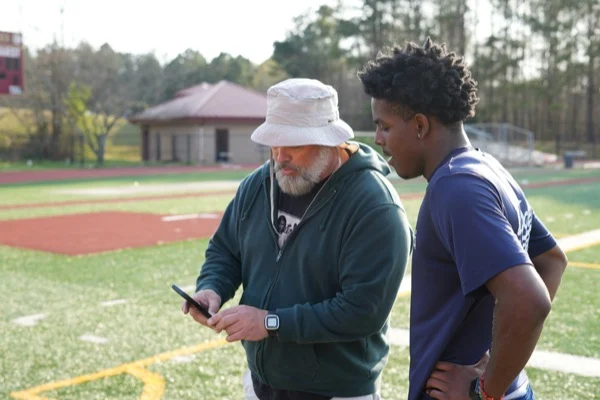
A companion to S1:E13 of Different at Work, where Flo and I took “executive presence” apart. Flo finds the term annoying. I called it ableist on the air, and then I went looking to see whether the research would back me up or make me eat my words.
I’ve been told I need to work on my executive presence. Every time, it landed the same way: like someone was coaching me to my personality. Not my work, not a decision I’d made… me. How I talk. How long I take to get to a conclusion. How I come across in a room.
Before anybody says it, I know. It sounds like sour grapes. Guy gets told to work on his executive presence, guy writes an article about why executive presence is the problem. (I see it.) But there’s something real underneath, and I don’t think most of the people handing out this feedback realize what they’re doing.
An umpire makes calls. Ball. Strike. You’re out. Nobody explains the strike zone, and you don’t get to ask what you should have done differently. “Work on your executive presence” is a call. A coach would have told you which pitch you missed.
Ah, gee, I got to give them something
Here’s how I’ve seen it used. You’ve got an employee who’s doing great, it’s review time, and the form has a box for development areas. You’ve got nothing. Ah, gee, I got to give them something… executive presence. Or someone’s up for the next director role and you can’t quite say why you don’t see them in it. There’s some it-factor missing. Executive presence.
It’s a catch-all, and it was kind of built to be one. Sylvia Ann Hewlett’s research, the work that made the term mainstream, splits it into gravitas, communication and appearance, and her own team found the feedback people got on it was so contradictory that 81% of women and people of color said they were unclear how to act on it (Center for Talent Innovation). Eighty-one percent. That’s not a development plan, that’s a fog machine.
“Culture fit” is the same animal. When sociologist Lauren Rivera interviewed people who hire for elite firms, “fit” mostly came down to shared hobbies, background and how people carried themselves, and it often beat out evidence about how well someone would actually do the job (Rivera, 2012). If you’ve ever been told you weren’t a culture fit and nobody could name a behavior… now you know.
Nobody taught them any different
I don’t think most managers who reach for this term are bad people. I think nobody trained them.
People get promoted into management because they were great at the job before it. Economists who looked at sales workers across 131 companies found the best sellers were the most likely to get promoted, and among the ones who did, the better their sales had been, the worse they did as managers (Benson, Li & Shue, 2019). So you take your best individual contributor, hand them a team, and (usually) not a whole lot else.
Training on different kinds of brains? In a 2024 survey of more than a thousand UK employers, only 18% trained line managers in how to respond when someone tells them they’re neurodivergent (CIPD, 2024). That’s the UK. The US doesn’t track it well enough for me to give you a number, which is its own kind of answer.
So what do you do when nobody taught you how to lead? You lead from what you’ve seen. The person giving executive presence feedback is usually a rung or two above you. They already jumped through the hoops to be seen as having it by the leaders before them, and now they’re filtering your development through their lens. Psychologists call the mental picture we all carry around of what a leader looks like an implicit leadership theory, and we judge people against it mostly without noticing (Lord, Foti & De Vader, 198490043-6)). Rosabeth Moss Kanter described the company-wide version back in 1977: managers pick people like themselves, because similar feels predictable and predictable feels safe (Men and Women of the Corporation).
For a lot of us, the picture is Jack Donaghy from 30 Rock. Well-groomed, great suit, could convince you of anything. If that’s the picture in your manager’s head, plenty of us are never going to match it- and that’s okay, because it was never the job.
Where it turns ableist
“That word is ableist” is a big claim, so let me shrink it to one I can actually defend.
The parts of executive presence that matter are real: inspiring people, communicating clearly, getting a group moving toward the same goal. What gets me is the assumption that there’s one right way to look while you do it, and that the right way happens to come easier to a neurotypical brain. Steady eye contact. Quick, polished answers. No fidgeting. Oh, he takes an extra minute to form his conclusions… executive presence.
Disability scholar Fiona Kumari Campbell describes ableism as treating one kind of body and mind as the standard and ranking everybody else against it (Contours of Ableism, 2009). That’s my line. Coaching toward an outcome the job needs is fine. Coaching someone toward a picture, when the picture was built around one kind of brain, is where it turns ableist. Sociologists Deborah Foster and Victoria Wass made more or less this argument about the “ideal worker” and “organisational fit” over a decade ago (Foster & Wass, 2013).
Two studies stuck with me. In one, people watched short clips of autistic and non-autistic adults, and within seconds rated the autistic adults less favorably and were less interested in talking to them. When people read transcripts of what was said instead, the gap went away (Sasson et al., 2017). Same words. Different delivery. That study wasn’t about performance reviews, but it’s the same problem: we judge the delivery before we’ve even heard the substance. In the other, brain imaging showed that forced eye contact over-activates the face-processing system in autistic people (Hadjikhani et al., 2017). So “just make more eye contact” isn’t the small note it sounds like.
US disability law already asks the question I want managers asking. Under the ADA, a standard that screens out people with disabilities has to be job-related and consistent with business necessity (42 U.S.C. §12112(b)(6)). That rule covers hiring standards, not a coaching conversation, but the question travels well: does this actually matter for the role?
(For what it’s worth, the definition is getting better. Hewlett’s 2024 update found inclusiveness, listening and authenticity gaining ground (Hewlett, 2024). The performance reviews just haven’t caught up yet.)
Toastmasters is fine. Masking isn’t.
None of this means you can’t work on presence. Join Toastmasters. Take an improv class. Do community theater. Plenty of neurodivergent people do, get really good at holding a room, and still lead from their actual strengths: problem-solving, empathy, spotting the pattern nobody else saw.
A lot of the difference is who picked it and why. If you chose it because you want the skill, you’re probably adding something. If somebody handed it to you so you’d look more like their picture… there’s a good chance you’re being asked to mask, and masking costs something. Autistic adults describe camouflaging as exhausting and link it to stress and depression (Hull et al., 2017), and autistic burnout shows up as chronic exhaustion and lost skills (Raymaker et al., 2020). We got into that in the burnout episode. And it’s not a clean line either way. A class you picked yourself can turn into masking if the real goal is to hide, and a suggestion from your boss can turn out to be exactly the skill you wanted. Same Toastmasters club, very different experience.
You don’t know their diagnosis
This is one we’ll keep saying on the show. At work, you don’t know someone’s diagnosis unless they’ve told you, and most people haven’t. In one Wilder Research survey, only 38% of neurodivergent people had told their most recent employer (Wilder Research, 2017). A lot of us didn’t even know ourselves until well into our careers. And you generally can’t ask (EEOC).
So go into every one of these conversations like the person in front of you might be wired differently than you. Because they might be.
In practice, that means you don’t coach someone on their executive presence. You ask about the work:
- How do you think the readout went? What would you change?
- How comfortable are you presenting to the leadership team?
- What would make it easier: the questions ahead of time, a written follow-up, a dry run?
- Want me to send you some stuff on presenting? No pressure either way.
Then let them pick what to work on. Coach to self-discovery. They might not know the why yet, either.
It’s not just the nicer way to do it. A big review of feedback research found that feedback helps on average, but more than a third of feedback interventions actually made performance worse, and feedback did worse the more it pulled attention off the task and onto the person (Kluger & DeNisi, 1996). “Work on your executive presence” points about as squarely at the person as feedback can.
It’s also closer to what coaching is supposed to be. In a lot of companies, “coaching” means being told what’s wrong with you. The International Coaching Federation defines it as “partnering with clients in a thought-provoking and creative process that inspires them to maximize their personal and professional potential” (ICF). Partnering. Questions. Their goals. That’s a coach. The other guy has a mask and a chest protector, and he’s yelling “strike.”
If you’re on the receiving end
With ADHD, feedback that sounds critical can land like a personal attack. (Rejection sensitivity is real. We did a whole episode on it.) So:
- Take a breath before you react, and notice where you feel it.
- Ask for an example, and what outcome it affected. If they can’t name one, that tells you something too.
- If you’re too embarrassed to ask “what exactly do you mean?”… ask anyway. Or ask someone you trust who’s seen you work.
- Decide which skills you actually want to build.
And like Flo says, feedback is a gift. Not every gift needs to be kept.
One last thing, for the leaders. Whoever gave you your executive presence feedback was probably doing their best with the picture they were handed, same as you. You don’t have to hand it down. There’s more than one path to the top, and the person behind you doesn’t have to follow exactly in your shadow… they might be bringing something you don’t even understand yet. Ask them about it before you make the call.
Keep being you. Different at work.
Sources
- Benson, A., Li, D., & Shue, K. (2019). Promotions and the Peter Principle. The Quarterly Journal of Economics, 134(4), 2085–2134. https://doi.org/10.1093/qje/qjz022
- Campbell, F. K. (2009). Contours of Ableism: The Production of Disability and Abledness. Palgrave Macmillan.
- Center for Talent Innovation. Executive Presence: Key Findings. https://coqual.org/wp-content/uploads/2020/09/26_executivepresence_keyfindings-1.pdf
- CIPD. (2024). Neuroinclusion at Work (with Uptimize). https://www.cipd.org/globalassets/media/knowledge/knowledge-hub/reports/2024-pdfs/2024-neuroinclusion-at-work-report-8545.pdf
- Foster, D., & Wass, V. (2013). Disability in the labour market: An exploration of concepts of the ideal worker and organisational fit that disadvantages employees with impairments. Sociology, 47(4), 705–721. https://doi.org/10.1177/0038038512454245
- Hadjikhani, N., Åsberg Johnels, J., Zürcher, N. R., Lassalle, A., Guillon, Q., Hippolyte, L., et al. (2017). Look me in the eyes: Constraining gaze in the eye-region provokes abnormally high subcortical activation in autism. Scientific Reports, 7, 3163. https://doi.org/10.1038/s41598-017-03378-5
- Hewlett, S. A. (2024, January/February). The new rules of executive presence. Harvard Business Review. https://hbr.org/2024/01/the-new-rules-of-executive-presence
- Hull, L., Petrides, K. V., Allison, C., Smith, P., Baron-Cohen, S., Lai, M.-C., & Mandy, W. (2017). “Putting on my best normal”: Social camouflaging in adults with autism spectrum conditions. Journal of Autism and Developmental Disorders, 47(8), 2519–2534. https://doi.org/10.1007/s10803-017-3166-5
- International Coaching Federation. What is coaching? (ICF Australasia). https://www.icfaustralasia.com/resources/what-is-coaching
- Kanter, R. M. (1977). Men and Women of the Corporation. Basic Books.
- Kluger, A. N., & DeNisi, A. (1996). The effects of feedback interventions on performance: A historical review, a meta-analysis, and a preliminary feedback intervention theory. Psychological Bulletin, 119(2), 254–284. https://doi.org/10.1037/0033-2909.119.2.254
- Lord, R. G., Foti, R. J., & De Vader, C. L. (1984). A test of leadership categorization theory: Internal structure, information processing, and leadership perceptions. Organizational Behavior and Human Performance, 34(3), 343–378. https://doi.org/10.1016/0030-5073(84)90043-6
- Raymaker, D. M., Teo, A. R., Steckler, N. A., Lentz, B., Scharer, M., Delos Santos, A., et al. (2020). “Having all of your internal resources exhausted beyond measure and being left with no clean-up crew”: Defining autistic burnout. Autism in Adulthood, 2(2), 132–143. https://doi.org/10.1089/aut.2019.0079
- Rivera, L. A. (2012). Hiring as cultural matching: The case of elite professional service firms. American Sociological Review, 77(6), 999–1022. https://doi.org/10.1177/0003122412463213
- Sasson, N. J., Faso, D. J., Nugent, J., Lovell, S., Kennedy, D. P., & Grossman, R. B. (2017). Neurotypical peers are less willing to interact with those with autism based on thin slice judgments. Scientific Reports, 7, 40700. https://doi.org/10.1038/srep40700
- U.S. Code, 42 U.S.C. §12112(b)(6) (Americans with Disabilities Act). https://www.govinfo.gov/content/pkg/USCODE-2010-title42/pdf/USCODE-2010-title42-chap126-subchapI-sec12112.pdf
- U.S. Equal Employment Opportunity Commission. Enforcement guidance: Disability-related inquiries and medical examinations of employees under the ADA. https://www.eeoc.gov/laws/guidance/enforcement-guidance-disability-related-inquiries-and-medical-examinations-employees
- Wilder Research. (2017). Neurodiversity in the Workplace. https://www.wilder.org/wilder_research/neurodiversity-in-the-workplace/
Hear more on the podcast, free in your app